How Accurate Are AI Detectors, Really? (What the Numbers Mean)
AI detectors claim 99% accuracy — reality is messier. What detection accuracy really means, why false positives happen, what breaks detectors, and how to read a confidence score.
Every AI detector’s marketing page says something like “99% accurate.” Every frustrated user has a story about a real photo flagged as AI, or an obvious fake waved through. Both things are true at once — and understanding why is the difference between using detection well and being misled by it.
We build a detector, so consider this the vendor’s honest version of the accuracy conversation: what the numbers actually measure, what breaks them, and how to read results like an analyst instead of a believer.
What “99% accurate” actually measures
A detection accuracy figure is a lab number: it says the model separated a particular test set of AI and real media that well, under that test’s conditions. Three things follow immediately:
- It’s tied to the test set. A detector scoring 99% against last year’s generators can stumble on this month’s — detection is a moving target by definition.
- Accuracy hides the error direction. 99% accuracy on a balanced set still means misses and false alarms; which kind dominates matters enormously in practice.
- Lab conditions are generous. Clean, uncompressed, full-resolution files — which is precisely what the internet doesn’t give you.
Independent evaluations of image detectors in 2025–2026 typically place good tools in the 85–94% range on clean media, with meaningful drops on compressed or degraded content. Any figure above that deserves the question: measured on what?
Why real photos get flagged (false positives)
The false positive — a genuine photo called AI — is the failure mode that erodes trust fastest, and it has mundane causes:
- Heavy processing looks synthetic. Beauty filters, smartphone computational photography, HDR merging and aggressive denoising all smooth textures the way generators do.
- Recompression destroys texture. Every re-upload flattens the natural noise detectors rely on; a fifth-generation WhatsApp forward has lost most of its “realness” signal.
- Studio perfection resembles the training data of generators. Flawless lighting on a flawless subject is, statistically, what AI images look like.
The mirror image — the false negative — comes from the arms race itself: each generator release is partly trained to look statistically natural, and adversaries can post-process fakes (add noise, recompress) specifically to launder the fingerprints away.
What actually breaks detectors
Ranked by impact:
- Compression and re-uploads — the single biggest accuracy killer in real use.
- Screenshots — a screenshot of an AI image is a real capture of a fake, muddying both metadata and pixel statistics.
- Novel generators — a model architecture the detector never trained against.
- Mixed media — a real photo with one AI-edited region; whole-image verdicts blur when only 10% of the pixels are synthetic.
- Tiny inputs — thumbnails and heavily cropped images simply don’t contain enough signal.
Why multi-signal detection holds up better
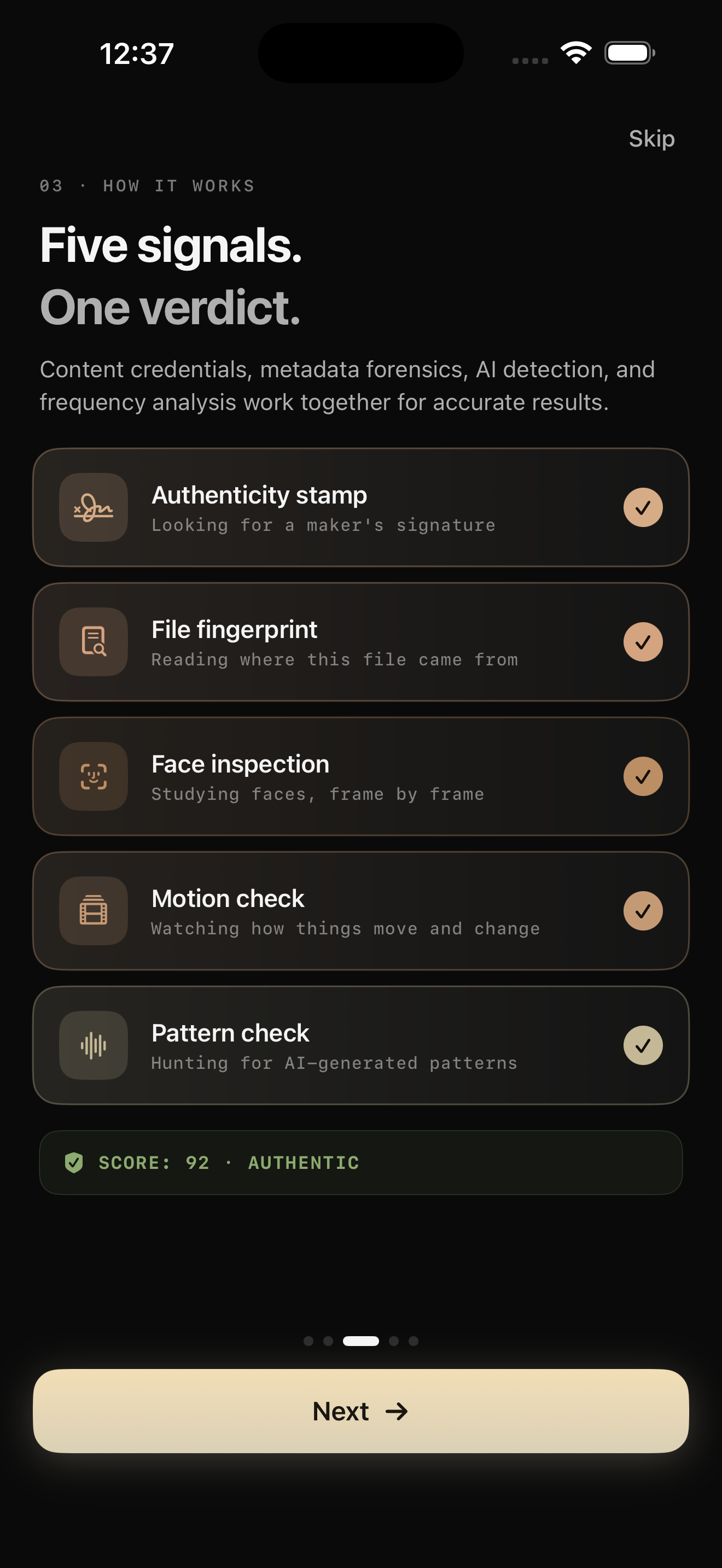
Everything above describes single-model fragility: one neural classifier, one point of failure. The forensic approach fuses independent signal families — provenance credentials, metadata and encoding forensics, neural face analysis, motion consistency for video, frequency-domain fingerprints — each of which fails differently. Compression hurts frequency analysis but not provenance; a novel generator evades the classifier but still leaves encoding anomalies; a screenshot kills metadata but not face-level artifacts.
That’s the design behind Verifyco: five signals fused into one 0–100 confidence score, computed on-device on your iPhone, with the per-layer breakdown visible — so you can see which evidence drove the verdict rather than trusting a black box. (The full checklist of what each layer catches: images · video.)
How to read a confidence score like an analyst
- Treat scores as evidence weight, not truth. 90+ means the signals strongly agree; it doesn’t mean 90% probability the file is real. Combine it with source, context and motive — who benefits from you believing this?
- “Inconclusive” is information. It usually means the file has been degraded past reliable analysis — which itself tells you the media has travelled far from its origin. An honest tool says so; a tool that never says so is guessing silently. (This is criterion #4 in our guide to choosing a detector app.)
- Weigh the layers. A low score driven by missing metadata is weak evidence (everything on social media lacks metadata); a low score driven by frequency fingerprints plus face artifacts is strong.
- Never act on a single check for high stakes. For money, reputation or safety decisions, detection output is one input alongside provenance and out-of-band verification — the same fusion logic the detector uses internally.
Frequently asked questions
Can AI detectors be 100% accurate? No, and they never will be — detection is a statistical inference in an adversarial arms race. Anyone claiming certainty is describing a product that cannot exist. The realistic goal is strong, explained evidence that improves over time.
Why did a detector flag my real photo as AI? Most likely: heavy filtering or computational photography smoothed it into synthetic-looking territory, or repeated compression destroyed its natural noise. Try the original file (not the messaged/re-uploaded copy) and read the per-layer breakdown if your tool offers one.
Are AI image detectors admissible as evidence? Detector output is generally treated as investigative support, not conclusive proof — courts and fact-checkers weigh it alongside provenance, expert analysis and testimony. Its practical power is speed: it tells you within seconds where deeper scrutiny is worth it.
Do detectors get better or worse over time? Both, in a sawtooth: each new generator degrades detection, each detector update recovers ground. This is why a tool’s update cadence matters more than its launch-day accuracy claim — and why provenance standards like C2PA are being built in parallel: labels don’t decay the way statistical detection does.
The bottom line
AI detectors are genuinely useful and genuinely fallible — like every diagnostic test humans use. The failure isn’t in the tools; it’s in reading them as oracles. Use multi-signal analysis, read the breakdown, respect “inconclusive,” and fold the result into context. That’s not a weaker way to use detection — it’s the only way that survives contact with the real internet.