Someone Made a Deepfake of You: What to Do, Step by Step
Found a deepfake of yourself — a fake video, voice or intimate image? Here's the emergency checklist: evidence, takedowns, platform reporting, legal options and damage control.
Discovering a deepfake of yourself is a gut punch: a video of you saying things you never said, your face on a body that isn’t yours, your voice pushing a scam at your own family. It’s violating, it’s frightening — and it’s increasingly common, because making one now costs an attacker nothing.
Here’s the part victims are rarely told clearly: you have more leverage than you think. Platforms are legally pressed to remove this content fast, laws have caught up in much of the world, and the right first hour matters more than anything you do later. This is the checklist.
Step 1: Preserve evidence — before anything else
Your instinct will be to get it taken down instantly. Right instinct, wrong order. Takedowns delete the proof you’ll need for reports, lawsuits or police. First, spend ten minutes preserving:
- Screenshot everything — the content itself, the account posting it, usernames, view counts, comments, timestamps.
- Save the URLs of every copy you find, not just the first one.
- Download the file itself if the platform allows; a screen recording as fallback.
- Note discovery details: when you found it, who sent it to you, where it’s spreading.
Keep it all in one folder. If this ever reaches police or court, this folder is your case.
Step 2: Use the fast takedown lanes
Not all reporting paths are equal. In order of speed:
- Intimate-image content: every major platform has a priority lane for non-consensual intimate imagery — and in the US, the TAKE IT DOWN Act now legally requires platforms to remove reported NCII (including AI-generated) within 48 hours. Use the specific “non-consensual intimate imagery” report category, not the generic one.
- StopNCII.org: for intimate imagery (real or synthetic), this free tool creates a hash of the image, and participating platforms (Facebook, Instagram, TikTok, Reddit, Bumble and more) block uploads matching it — without you sending anyone the image.
- Impersonation reports: if the deepfake runs on a fake account of you, report the account for impersonation as well as the content — accounts often come down faster than individual posts.
- Search engines: Google has a dedicated removal request form for both non-consensual intimate images and AI-generated content depicting you. Getting it out of search results cuts most of its reach even before hosts act.
Recheck weekly: content that came down has a habit of being re-uploaded. The hash-matching route (StopNCII) is your best defence against re-uploads.
Step 3: Report to police — with the right framing
Whether police can act depends on where you live and what the deepfake does — see our companion piece on deepfake laws in 2026 for the map. When you file:
- Bring the evidence folder from Step 1.
- Frame it by the harm, which is what statutes attach to: intimate-image abuse, harassment, fraud/impersonation, defamation, or election interference.
- Get a case number even if the officer seems unsure — it unlocks platform legal-request lanes and matters later if things escalate.
If money is involved — a cloned voice or face used to scam your family or employer — treat it as fraud from minute one and involve the bank immediately; that playbook is in AI voice cloning scams.
Step 4: Control the narrative where it matters
You do not owe the internet a response. But for the people who matter — family, employer, school, close contacts — a short, calm heads-up beats letting the fake reach them cold: “A fabricated video of me is circulating. It’s fake, it’s reported, and it’s being removed.” If the deepfake targets you professionally, tell your employer’s HR/security team early; they’ve likely seen this before, and forewarned is disarmed.
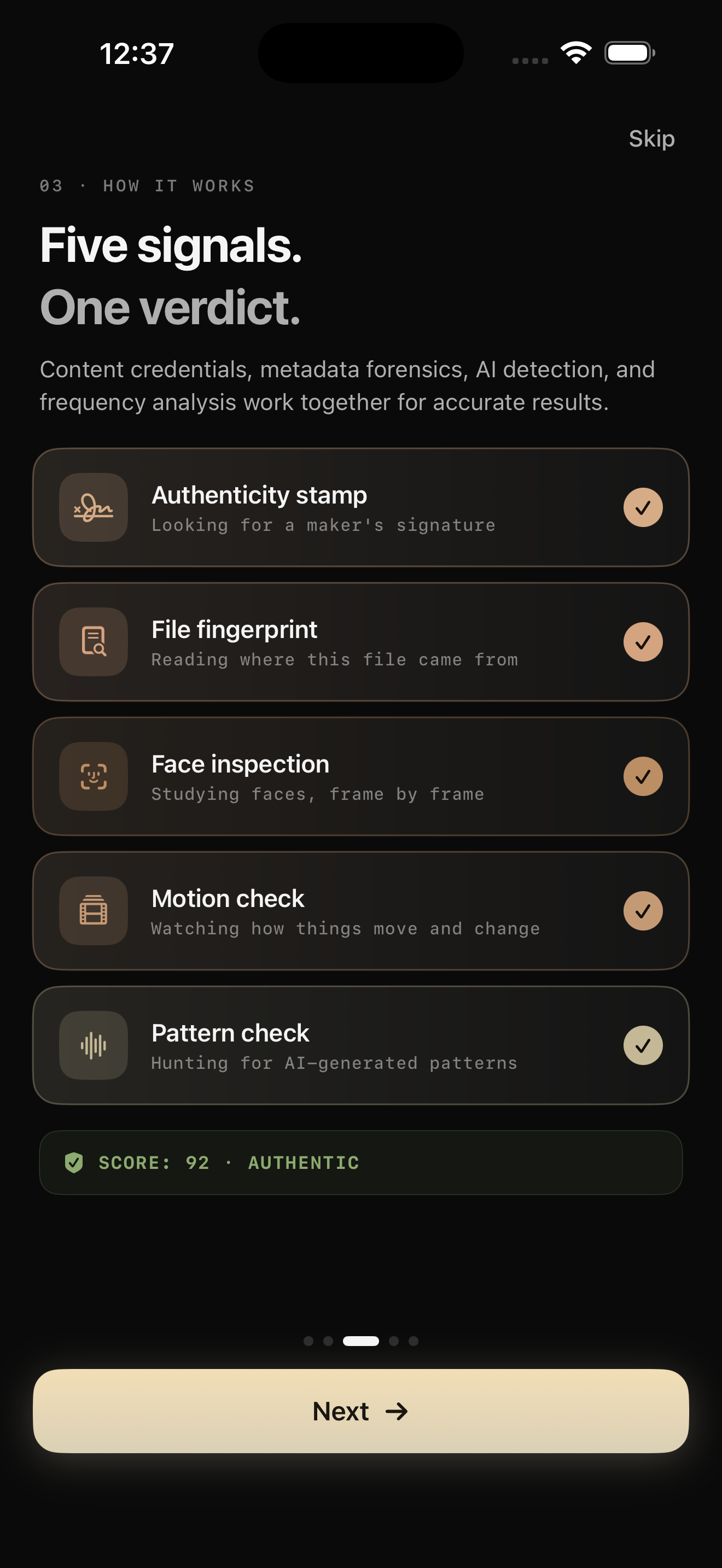
One more asset: proof of fakeness. Running the file through forensic analysis gives you something concrete to attach to reports and statements. Verifyco analyses the video or image on your iPhone — frame-to-frame consistency, generation fingerprints, metadata forensics — and produces a confidence verdict with a per-layer breakdown you can screenshot. It runs fully on-device, which matters here more than ever: this is content you should not be uploading to random web tools. (Deeper dive: how to tell if a video is AI-generated.)
Step 5: Reduce your future attack surface
After the fire is out:
- Lock down high-resolution, front-facing photo/video of yourself where strangers can scrape it; attackers build deepfakes from public media.
- Set up alerts (e.g., a name-search alert) so you find the next re-upload before your contacts do.
- Agree a family verification phrase — deepfakes of you are often aimed at your family’s wallet.
- If you’re a public-facing person, consider periodic reverse-searches of your own most-used portraits.
The mental-health note that belongs in this list
Victims consistently describe deepfake abuse — especially intimate-image abuse — as traumatic in the same register as physical violation. That reaction isn’t overreaction. Organisations like the Cyber Civil Rights Initiative run helplines and step-by-step support for exactly this. Handling the technical checklist doesn’t require handling the emotional weight alone.
Frequently asked questions
Can I force a platform to remove a deepfake of me? For intimate imagery in the US, yes — the TAKE IT DOWN Act mandates removal within 48 hours of a valid report, and similar duties exist under the UK Online Safety Act and the EU’s DSA. For non-intimate deepfakes, removal runs through impersonation, harassment and synthetic-media policies — slower, but usually effective when you use the right report category.
How do I prove the video isn’t real? You generally don’t carry the burden of proving fakeness to report it. But forensic evidence helps everything move faster: an on-device analysis report, inconsistencies in the video, and your own alibi evidence (where you actually were) all strengthen reports and legal claims.
Should I pay a “takedown service”? Be careful. Some are legitimate; some are scams that target victims twice. Everything in this guide — platform lanes, StopNCII, search removal — is free. If you do hire help, prefer a lawyer or an established victim-support organisation over an anonymous service promising guaranteed removal.
What if the deepfake is of my child? Escalate immediately: synthetic intimate imagery of minors is CSAM in most jurisdictions, full stop. Report to the platform under child-safety (not just NCII), to police, and in the US to NCMEC’s CyberTipline. Do not download or forward the content itself beyond what reporting requires.
The bottom line
The first hour: preserve evidence, then hit the fast takedown lanes. The first week: police report, narrative control, forensic proof. After that: shrink your attack surface and set tripwires. A deepfake of you is an attack, not an embarrassment — and the response playbook above works. For the background on how these fakes are made, see what is a deepfake.